

One of Keiki’s many obsessions is carnivorous plants. He has been maintaining a collection of around 7 plants, a mixture of nepenthes, sundews, and Venus flytraps. Recently he expressed a wish to acquire sarracenias (the more upright pitcher plants). Some sleuthing by the bloke revealed that there is an avid sarracenia grower around an hour’s drive from us, so he contacted them and asked if we could visit. They responded enthusiastically, so we set a date and off we went.
It was a fantastic place. There were five greenhouses, plus a number of cold frames and, apparently, a collection of the more tropical nepenthes that could only be glimpsed tantalisingly through the windows.


Keiki didn’t know where to go first. He went up and down the greenhouses, chattering away to other visitors (mostly older gentlemen) and peppering the owner with questions. He was delighted to meet an enthusiast who was so young. He’d started his collection when he was 14 - still had the original Venus fly trap that had started him off - and is now in his sixties.
We spent well over an hour there, and of course, before we left, Keiki managed to spot the rarest and most difficult hybrid to cultivate, which is in the photo at the top. He is now on the waiting list for the rhizome, which the grower can only split once a year.

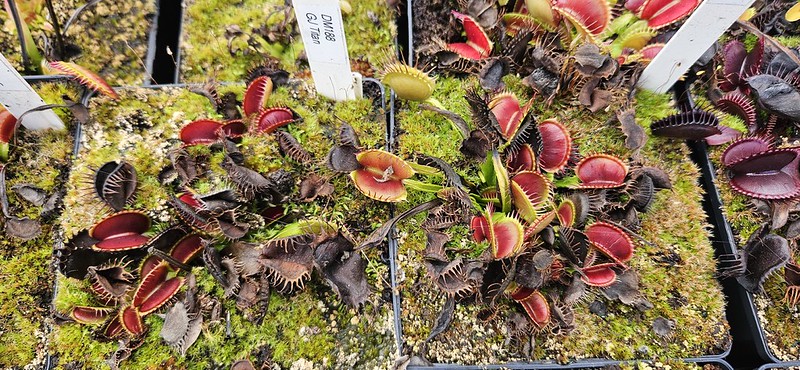
We came away with 7 new plants (pictured above): three sarracenia variants, a sundew and three Venus flytrap variants. The original deal was that he could get three, but it was just not quite enough with several hundred cultivars to choose from.
Our next trip will be to Chester Zoo, which apparently has the country’s largest collection of nepenthes.
tags:

From:
no subject
I love sarracenias and have kept them on my balcony for a while but then the tits learned how to make holes into the pitchers and the plants did not survive that. Maybe I will try again inside.
From:
no subject
One of the tips the grower gave us is that even when a plant dies back down to the rhizome, it is still possible to resurrect it in the spring if it is kept watered and pest-free. So even if all the pitchers are gone, he said not to throw it out until you've gone through a full seasonal cycle and it hasn't come back.
From:
no subject
Are you planning on greenhouses - especially if Keiki gets into propagation (and hybridisation)!?
From:
no subject
From:
no subject
From:
no subject
From:
no subject
From:
no subject
From:
no subject
From:
no subject
From:
no subject
From:
no subject
From:
no subject
From:
no subject
From:
no subject
From:
no subject
From:
no subject
From:
no subject
Although I keep a kitchen garden and such, I'm usually hopeless with any form of potted plant. I'm just glad I've kept them alive for two years!
From:
no subject
Congratulations on your success in keeping your carnivorous collection going!
From:
no subject
From:
no subject
From:
no subject
From:
no subject
(I also so very much appreciate that you and the bloke (and Humuhumu) appreciate and encourage Keiki's interests and the deep learning that comes with them as much as you possibly can. There are likely some wonderful memories being made.)
From:
no subject
From:
no subject
From:
no subject
From:
no subject
From:
no subject
From:
no subject
From:
no subject
From:
no subject
From:
no subject
Apparently glutinous rice steamed in pitcher plant pitchers are having a bit of a moment in Malaysia, they're a traditional Sarawakian food, but for obvious reasons environmentalists are advising against eating/making them.
From:
no subject
The pitchers make beautiful cooking vessels, but agree, unless you're harvesting pitchers from a plant you're maintaining indoors, please do not.
From:
no subject
All these ‘carnies’ are so showy! May Keiki's plants all flourish.
From:
no subject
From:
no subject
From:
no subject
From:
no subject
From:
no subject