![[personal profile]](https://www.dreamwidth.org/img/silk/identity/user.png)
As usual, the cats feature heavily. Not much travel in this one except at the very end. One big highlight for me is my masters students disassembling and re-assembling a sounding rocket experiment in the CubeSat facility.
As usual, the cats feature heavily. Not much travel in this one except at the very end. One big highlight for me is my masters students disassembling and re-assembling a sounding rocket experiment in the CubeSat facility.

I had my Year 1 tutees make cyanotypes in their most recent group tutorial. I asked them to make images of their favourite things they'd learned about in the first year so far. They took the prints home with them, but I kept the transparencies so I can make copies.
To celebrate the end of exams and what, for some of the students, is very nearly the end of their undergraduate careers, we got to have a practical flight test experience today in a Piper PA-28 Warrior II, a delightful little aircraft that resembles an old Buick in more ways than one.

Flight path data from today.

Me with the plane.

My view from the plane.

My project student flying the plane!

She's a natural. :)

After pulling 2g. Everything is fine. Just keep your eyes on that horizon.
Trying to keep a proper flight log of the tests whilst balancing the urge to gawp out the window and excitedly take photos of everything proved pretty much impossible, so I was grateful we weren't being assessed. I had a blast. What a treat to have this as a first flight after 16 months of being grounded.
Flight path data from today.
Me with the plane.
My view from the plane.
My project student flying the plane!
She's a natural. :)
After pulling 2g. Everything is fine. Just keep your eyes on that horizon.
Trying to keep a proper flight log of the tests whilst balancing the urge to gawp out the window and excitedly take photos of everything proved pretty much impossible, so I was grateful we weren't being assessed. I had a blast. What a treat to have this as a first flight after 16 months of being grounded.
February 18
February 19
Finally, here are the two most recent wonderful misinterpretations that the auto-captioning software on Panopto offered up on my pre-recorded lecture material.
My name: Anthony Anketell [no.]
A phrase: "If all of the subsystems have a bank of horsepower bear," [backup or a spare]
What are you most fascinated by at the moment?
Finding ways to prove that we should make STEMM subjects more accessible by actually talking about endemic issues with discriminatory language and culture in higher education and industry while teaching technical topics, not as an afterthought or an optional add-on.
Space debris and space traffic management.
February 19
What are the three most dominant emotions in your life right now?
Determination, ambition, and mild panic.
My name: Anthony Anketell [no.]
A phrase: "If all of the subsystems have a bank of horsepower bear," [backup or a spare]
tags:
Yesterday was the 14th anniversary of me working on the European Space Agency's Cluster mission.
Today, I received news that one of my Year 1 Aero students, whom I helped with her application, has been accepted onto ESA's prestigious Fly A Rocket! programme.
That is just about the best anniversary gift I could have received.
Have a photo of an extremely tired me in my headphones, preparing to record a lecture, wearing my Cluster hoodie that was gifted to me by my magnetometer lab colleagues. All that blurry stuff is the cracking around my phone's front camera. I need to replace my phone. There is no time to shop for a new phone. *thud*

Today, I received news that one of my Year 1 Aero students, whom I helped with her application, has been accepted onto ESA's prestigious Fly A Rocket! programme.
That is just about the best anniversary gift I could have received.
Have a photo of an extremely tired me in my headphones, preparing to record a lecture, wearing my Cluster hoodie that was gifted to me by my magnetometer lab colleagues. All that blurry stuff is the cracking around my phone's front camera. I need to replace my phone. There is no time to shop for a new phone. *thud*
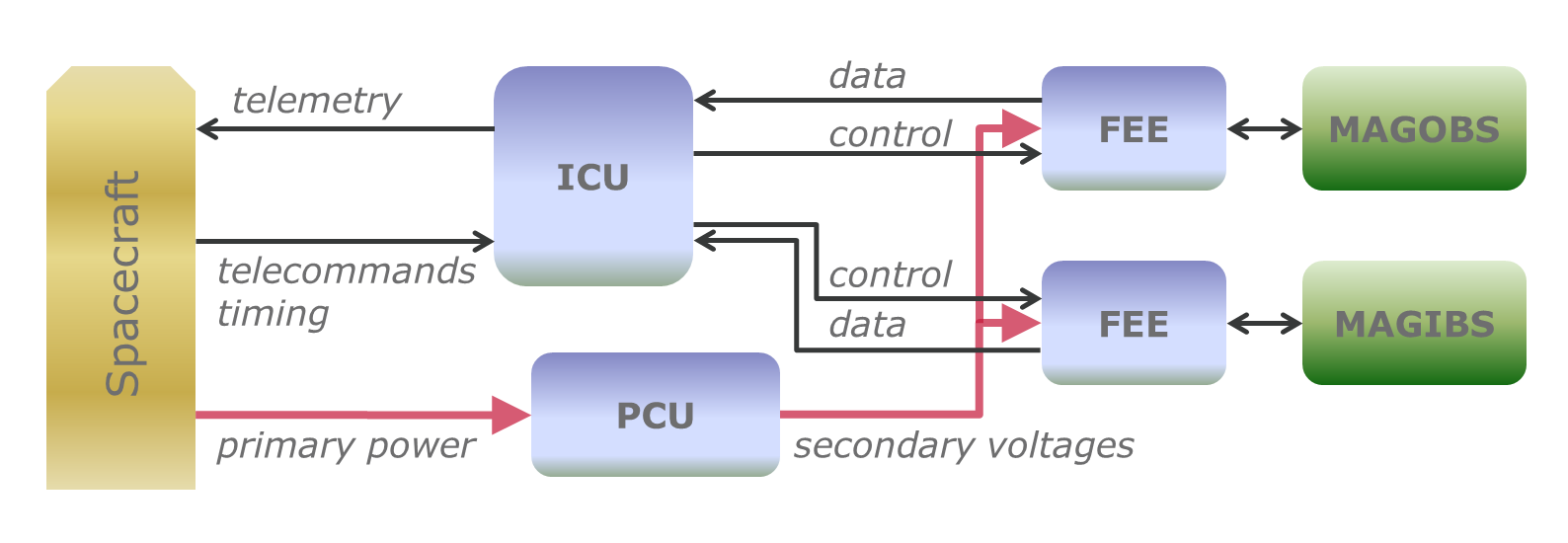
[Block diagram of a "generic" space instrument.]
I'm giving a talk next week* and I needed a block diagram of a generic spacecraft instrument. I made one many moons ago but it looks verry dated now and is also about 400x300 pixels and I can't find the original graphics program file. So I thought, I'll make myself a new one.
I'll probably talk about the slide it's on for a minute and a half, maybe two. I probably shouldn't have spent two hours on this. I'm now trying to justify the time spent to myself by sharing it with the internet. Hi, internet!
If you're wondering what this is, it shows how a set of sensors that measure physical parameters in space (on the right in green, labeled MAGOBS and MAGIBS) are connected to a spacecraft (on the left in gold). The physical parameter, in the case of these two sensors, is the ambient magnetic field.
The FEEs transform the physical parameters measured by the sensors into electrical signals.
The ICU is the instrument control unit, which takes telecommands (TCs) and timing signals from the spacecraft and passes them to the sensors. It also takes the data passed back from the front-end electronics (FEEs) and turns it into nice telemetry packets (TMs) that the spacecraft can then package up and beam to Earth through its communications system.
The PCU is the power converter unit, which takes the standard voltage from the spacecraft (usually +28 Volts) and chops it up into secondary voltages that the instrument FEEs can use (e.g. +/- 1.5 Volts)
It all looks very simple, no? You wouldn't think this sort of thing would take a dozen years or so to implement and launch would you? Sadly, you would be wrong about that.
* And two the week after that. They are all different. Whyyyy did I think it would be a good idea to sign up to give a group meeting when I already knew I had another two talks to give? /o\
Every year since 2009 I've demonstrated in Instrumentation lab in the autumn term. Instrumentation is a third/fourth year elective Physics course, and normally about half of the students also do the lab.
Every year we have between 10 and 30 students in the lab. Every year a percentage of them is female. At most, about a quarter of them. One abysmal year it was 5%.
This year, we have 14 students. Seven of them are female.
Seven. SEVEN. Half of this third-year lab is FEMALE. We have never even been close to parity before.
And they're good, too, all of the students. Some are stronger than others, of course, but overall the standard is high.
TL;DR: HALF MY PHYSICS STUDENTS ARE FEMALE. THIS IS AMAZING. I AM SO HAPPY ABOUT IT. THIS HAS PRETTY MUCH MADE MY YEAR IN TEACHING Y'ALL.
WIN \o/ \o/ \o/
Every year we have between 10 and 30 students in the lab. Every year a percentage of them is female. At most, about a quarter of them. One abysmal year it was 5%.
This year, we have 14 students. Seven of them are female.
Seven. SEVEN. Half of this third-year lab is FEMALE. We have never even been close to parity before.
And they're good, too, all of the students. Some are stronger than others, of course, but overall the standard is high.
TL;DR: HALF MY PHYSICS STUDENTS ARE FEMALE. THIS IS AMAZING. I AM SO HAPPY ABOUT IT. THIS HAS PRETTY MUCH MADE MY YEAR IN TEACHING Y'ALL.
WIN \o/ \o/ \o/
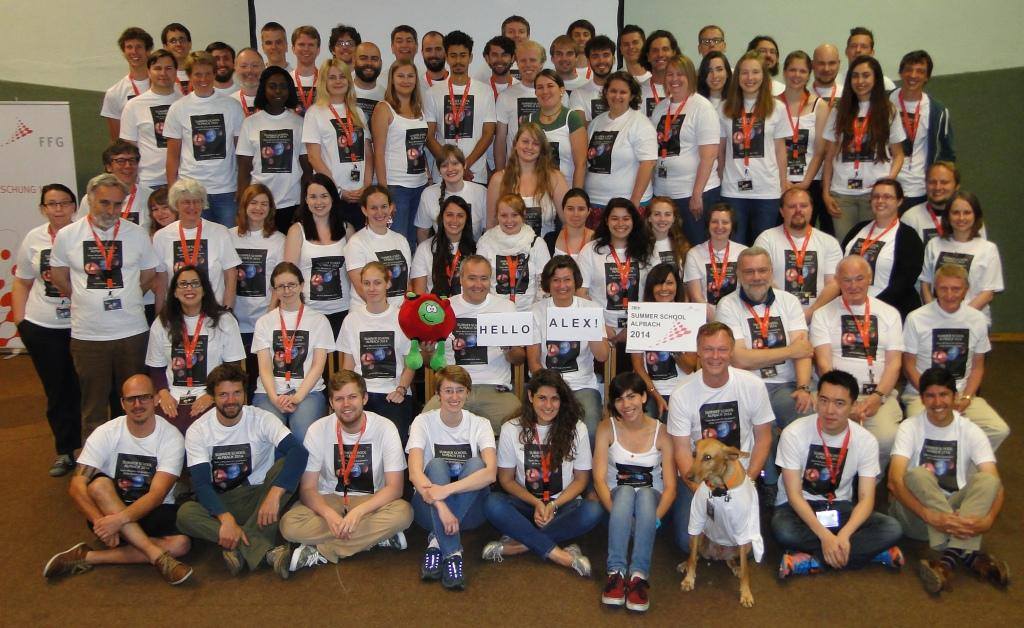
[The 2014 Alpbach Space Summer School participants. Photo not mine - pinched from Paxi the ESA mascot's home page. I made this picture a bit bigger than I normally do for posted photos. Can you see me?]
I missed a day of posting. This was a tactical mistake, as a day in Alpbach time is more like a week in terms of eventfulness. I'm up super-early on Wednesday morning in order to catch up, as today will be more of the same. The four student teams have until midnight tonight to hand in their final reports and presentations, after which neither can be altered. They go before the jury tomorrow and the winners are announced at Thursday's dinner.
Fished from what now feels like the dark recesses of distant memory, Day 7.
Monday began with the last set of lectures. These were rather thinly attended compared to the previous week, as around half of each team decided to skip them in favour of preparing for the preliminary design review. I found this a bit sad as the lectures were quite good. The first lecture was given by a very prominent French scientist, who, despite his habit of muttering through his beard, gave a rather beautifully structured overview of the last fifty-odd years of space exploration of the terrestrial planets (including the Moon). The slides were so good I've pinched them and asked permission to use some of them for future outreach talks. The penultimate and final lectures were given by a nearly as prominent but very shy German scientist, who talked about the outer planet's moons and the study of exoplanets. I was pleasantly surprised later to learn that the students found these inspiring, since neither of them were helpful in an immediate sense for their mission design for this school.
During the coffee break, our school's photographer took the group photo above, which (I believe) has been sent to the ISS. Alexander Gerst, the German astronaut currently aboard the space station, is an alumnus of the Summer School and headed a team while he was here.
When the last lecture finished, the students dispersed to wolf down their lunches and continue preparing for their Preliminary Design Reviews*, which took place at 1630. I was on a review panel with a fellow roving tutor and the French lecturer from the morning. During the review, the lecturer got out his laptop and started typing. Even I found this slightly unnerving, and I wasn't the presenter. What the students would've found even more unnerving is that he wasn't answering e-mail or even updating his Facebook status. Oh no. He was correcting their orbit calculations. With hindsight, we probably did the review in reverse order. We (said lecturer and I) began by giving them a lot of critical feedback, which was positively phrased, but also probably didn't help their nervousness. This is a fault of mine. I tend to jump straight into problem-solving. The third juror, a quiet and lovely man, didn't speak until we were nearly finished. He praised them both for the strength and originality of their scientific idea and for the quality of their presentation. This was good because it bolstered their confidence, on top of making them realise how much work they still had to do.
We dashed back to the hotel after the review for our tutor meeting at 18:00. The feedback was largely positive apart from one team. Flushed with the success of their requirements review (the one that I had attended on Day 4), they presented only two slides much too quickly and therefore missed a step in preparing for the final presentation, which lasts an hour. All of the team tutors are invested in their teams' success, but the two tutors for this team are so much so that they're practically part of the team and they looked gutted. (If you're finding yourself distressed on their behalf, don't worry; the team and their tutors have since recovered!)
We went to dinner to find a significant proportion of the students missing (mostly from that team), since they'd decided to stay in the Schoolhouse and prepare for their delta review. It transpired that it was the birthday of one of the team tutors. Every night one representative from each team has to stand up and describe briefly the team's progress. The teams are called in random order. His team (the one that featured strongly in my early posts and has gone from having the worst to probably the best team dynamics in five days) decided to break the rules by requesting to go last, and by all standing up together and rapping a poem they'd written in his honour. It was adorable.
We returned to the Schoolhouse after dinner. The tutors finally exited after midnight. Sadly, since it was Monday we couldn't find anywhere to have a beer in honour of the birthday boy. But I wouldn't say he came off too badly, given that he now has his very own song, immortalised forever on the Summer School's Facebook page.
Extracted from the fog of my underslept brain, Day 8.
Although the church bells woke me at 7 AM, I needed to get some work done so I didn't head to the Schoolhouse until nearly 10 AM. I visited each team in turn, but they were all so intent upon their individual tasks that I just sat quietly in the rooms working unless asked a question. Having been chastised by a member of one team who thought I hadn't spent enough time with them (true, but this is because every time I went in and offered to help, no one took me up on it!), I sat in their room with parts of their engineering group for a while in the afternoon prior to the Final Design Review.
I left shortly before the review, as I was part of their review panel, along with the head of the Summer School, who is also the head of the Austrian Space Agency. (I bet that wasn't intimidating for them at all, oh no.) They did pretty well, although for some mysterious reason they still had an abundance of speakers when it's plain that they only need one - the chap whom they appointed their spokesperson on the very first day. He has all the qualities and the complete vision of the mission that a leader needs, and I think their failure to recognise it stems from the relative youth of this team. We gave them plenty of feedback on their presentation. I stressed to them that if they performed a duty cycle calculation a lot of the problems with incorrect budgets and assumptions in their presentation would magically disappear. I also (after some discussion with the team tutors, who were wary of appearing biased), returned later in the evening to suggest to them that they appoint a single spokesperson for their final presentation and hinted strongly at the identity of the person they should consider appointing. They seemed to take it well, but who knows what they will decide in the end - one of the fun things about this process is the unpredictability of the students!
* Just to give you some perspective on how accelerated this timetable is, the JUICE mission was selected in 2012. We had our first requirements review last year. We have two more reviews before PDR, which is still over a year away.
tags:
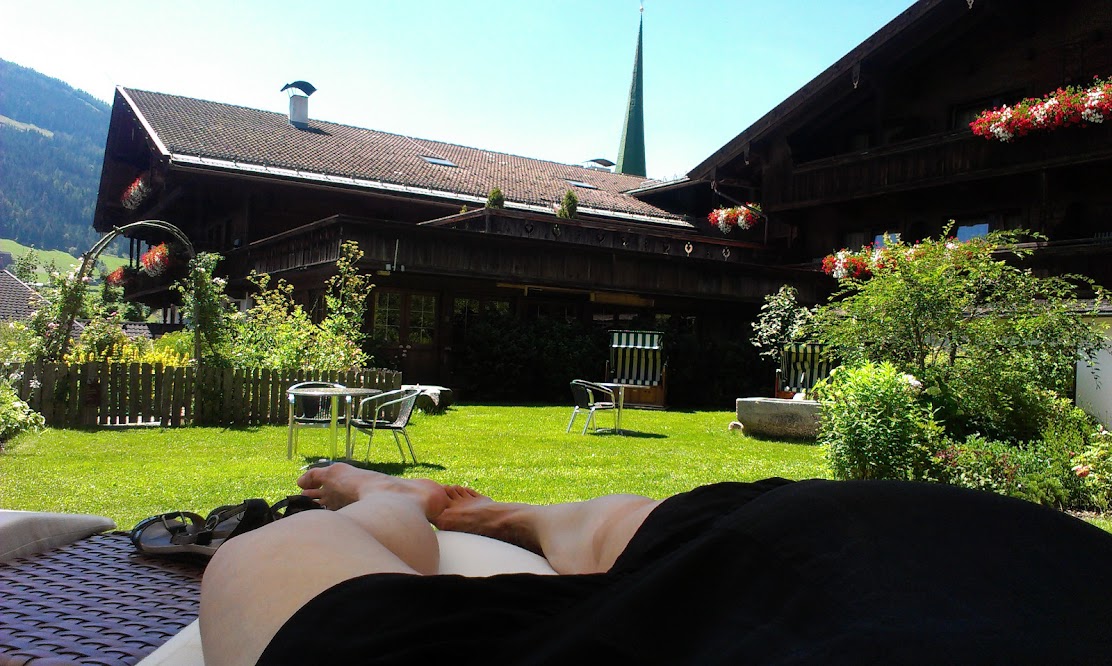
[View over my outstretched legs as I relax on a lounge chair in the hotel garden.]
Most of the students and a fair number of tutors went on alpine hikes yesterday. Given that hauling my pregnant self from the Schoolhouse to the hotel, a distance of about 400 metres at an incline of OMG STEEP, leaves me breathless in the current heat wave (30+ degrees C), I decided not to go. I spent the morning and early afternoon alternately working and resting.
Just before 16:00 I headed back to the Schoolhouse. A team tutor (science) for one of the teams had not yet returned from the hike, and their science team was in disarray. With the permission of the other (engineering) tutor, I stepped in to marshal them to order. I put all their science objectives up on the blackboard and assigned the requirements to the members of the science team according to their interests. Some of them were already working on them, but no one knew what anyone else was doing, so there were both gaps and overlaps. One of them wanted to rewrite the objectives (not just the requirements, the original science objectives). I had to give my speech again about it being far too late for that and needing to move forward because they must have a payload (and spacecraft(s) and mission scenario e.g. orbits) by Monday. They settled down to do some serious work.
Once the scientists got organised, they started putting some numbers up on the board, which gave the payload and mission (orbit) analysis teams something to work with. After dinner, the team reconvened and each scientist took it in turn to explain and defend their numbers to everyone else.
All of this took most of the afternoon and the evening and I'm deliberately glossing over the details, but it was wonderful to watch the transformation from utter chaos and despair to order and optimism. Their leader, whom it was obvious to the tutors should have been the leader from the first day, had agreed very reluctantly to do so that morning. By the evening, he was in control, with the full backing of his peers. He called for a engineering review at 12:15 AM to ensure that the payload team were getting the interpretation of the science team's requirements right, and they identified where they'd need to have discussions or rethink the need for the given measurement range or resolution given available technologies.
I'm afraid I didn't rove much as a tutor yesterday since I got caught up in this team's struggle, so my goal for today is to wander more freely!
tags:
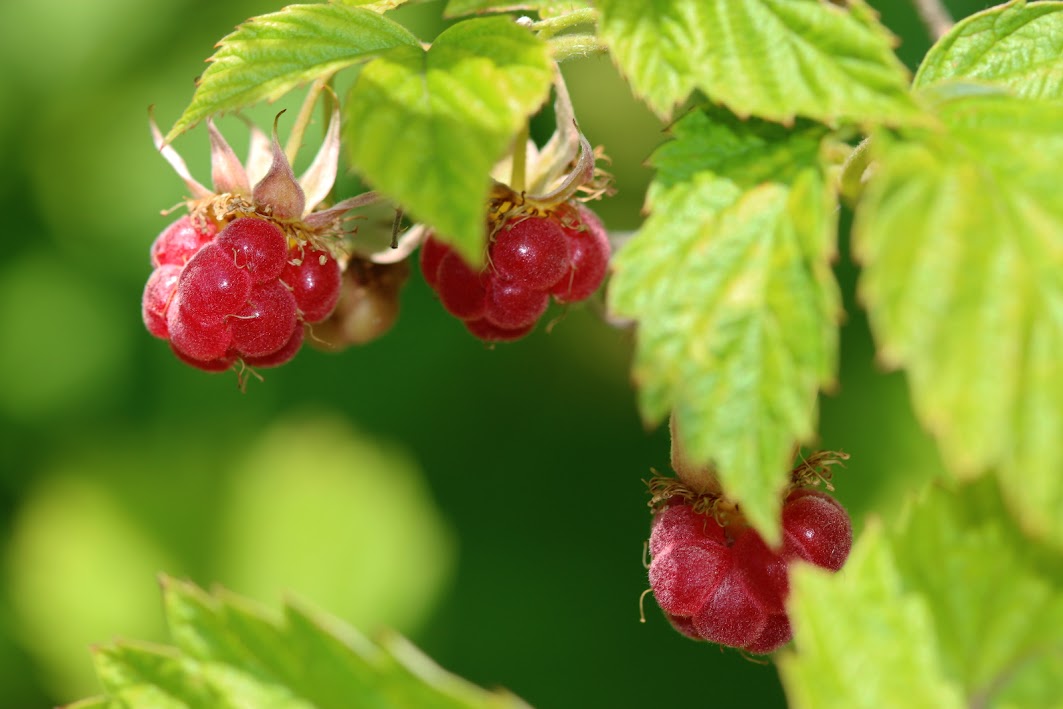
[Image of ripe raspberries peeking out from beneath young green leaves. They grow wild at the roadsides in the village and are tiny and delicious.]
Let me see if I can gather my scattered wits enough to summarise yesterday's events.
The mood at breakfast was somewhat subdued due to the arrival of one of the lecturers from ESTEC, bringing news that one of our ESA colleagues lost his mother in the downing of Flight MH17. She was returning home to Malaysia after three weeks with her children and grandchildren.
We had to carry on regardless, so we marched down to the Schoolhouse for the morning lectures, which were all about mission design and operations. The students were just beginning to look a bit haggard, most of them having been in the Schoolhouse until at least 1 AM preparing for their first reviews, which took place at 16:30.
The reviews ran in parallel for the four teams, with a set of roving tutors assigned to each team to ask questions and decide if the science case was solid enough for them to carry on drilling down from the science requirements into observational and payload requirements. We had learned earlier that all four teams had selected Venus as their target planet. The general reasoning appeared to be:
- Mercury is difficult to get to. Also, BepiColombo, which launches in 2016 and is targeting Mercury, is carrying multiple spacecraft (though not a lander or a rover) and a comprehensive payload which should advance considerably the state of knowledge about the planet.
- Mars' geophysical parameters have well characterised by many missions, mostly from NASA, and a lot of these are ongoing or soon to be launched. The students didn't feel confident enough that they could come up with a unique science question to justify a Mars mission, despite the lecturers that included very strong (sometimes blatantly obvious) hints in this direction.
- They applied similar reasoning to Earth as to Mars.
- The lecturer who spoke on Venus was far and away the best at selling the planet as an interesting target. He's also one of the tutors and the students really like him - he's engaging, approachable and knowledgeable. Additionally, so little is known about Venus' surface, atmosphere and interior (because it is such a harsh environment) that it is much easier to come up with a unique science mission.
Back to the reviews. The group I reviewed (with two others) had a really good science question and derived set of science requirements. We quizzed them in lots of different ways and their case stood up to the questioning well. They hadn't yet moved through to the next step (observational requirements), which they were supposed to have done, but I believe this was to their benefit as it meant they'd done a much better job of defining their science requirements that it seemed the other teams had done. They didn't need a delta review, although they decided to give themselves one anyway.
It was also fun to watch the dynamics of the team take shape. Their spokesperson, a charming and articulate young woman, knew when to defer to her science and engineering leads. The engineering lead is a shy Irish chap who had explicitly stated earlier that he didn't want to get up and speak. But later in the evening during the delta review (at 11:00 PM), he got up and presented a slide. It was informative and well researched, would help them move from their observational requirements into payload definition, and he did it quite well. We (one of the other roving tutors and I) made sure to compliment him on it afterward, and he positively glowed.
The first implosion took place last night as well. I returned to the Schoolhouse after dinner and moved from room to room, observing and trying to help. I walked into one room at 10:30 PM just as one of the team tutors was leaving with a face like thunder. "Meltdown," he said, "I need a walk." It transpired that the science team were in disarray. They have one particularly combative personality, and she was at the throats of the others (metaphorically). I'm not normally one for this kind of heavy-handed intervention, but it seemed to me to be required. I went in, stood by the table and said, "Hello" in my brightest, chirpiest American. They all stared at me. Confident that I had their attention, I picked up their requirements matrix and began to talk them through it. Occasionally they tried to say, "But we aren't doing X," or "Doing Y is too hard," and I said, no, it is too late to change or add things now (exactly what I'd watched their team tutor tell them an hour earlier). You have to move forward. (I must have said this five times in half an hour.) They had been stalled for too long and were achieving nothing. They needed to stop squabbling over whether they could achieve their science objectives with the instruments they had in mind. The science requirements needed to be turned into observational requirements and given to the engineers. The engineers needed to know which quantities were to be measured, to what precision and for how long. They are the ones who will worry about whether the instruments could achieve this and then whether or no they could afford it (in terms of mass, power, lifetime of the spacecraft, etc).
I have no idea if they actually took all that on board. I'll find out later today. Most of the students are on a hike and will return to the Schoolhouse at 16:00. I really hope I return to find that this team has produced an Observational Requirements matrix, or they're going to be badly behind. The next review (the Preliminary Design Review, which requires payload definition) takes place on Monday afternoon.
tags:
.


